Trading Type
Spot
Trade crypto freely
Promotions
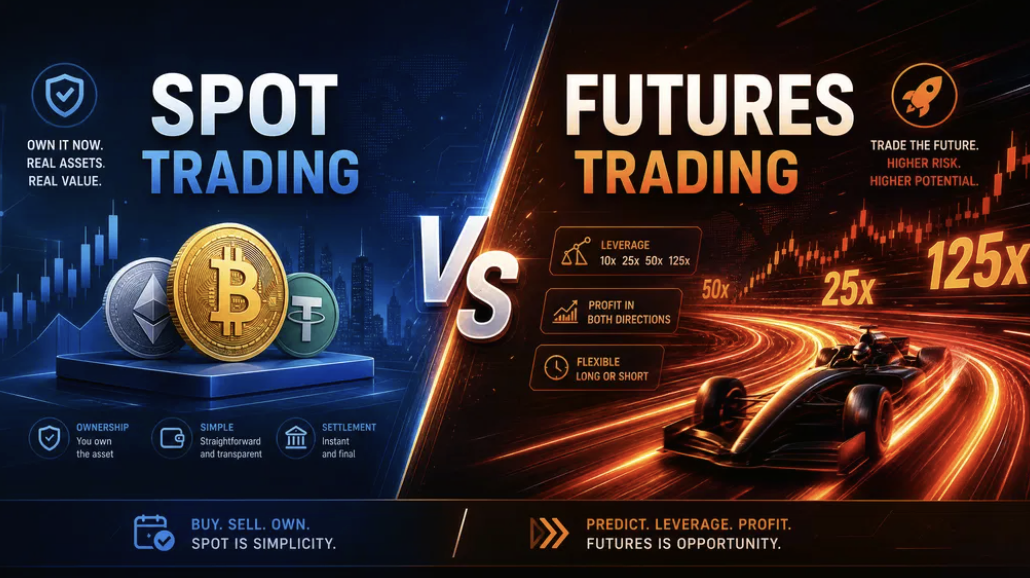
Spot trading refers to the direct purchase or sale of financial assets at the current market price, commonly called the spot price. Once the transaction is completed, ownership of the asset is transferred immediately between the buyer and seller.
In cryptocurrency markets, spot trading allows users to directly own assets such as Bitcoin, Ethereum, or other digital tokens. Traders can hold these assets long-term, transfer them to external wallets, or use them within blockchain ecosystems.
Spot trading is generally considered the most straightforward form of trading because it involves real asset ownership without the complexity of derivatives contracts.
Futures trading involves buying or selling contracts that represent the future value of an asset rather than the asset itself. Traders speculate on whether prices will rise or fall over time without necessarily owning the underlying asset.
In futures markets, contracts have predefined terms, including settlement conditions and expiration dates, although perpetual futures contracts commonly used in crypto markets do not expire.
Futures trading often includes leverage, which allows traders to control larger positions with a relatively small amount of capital. While leverage can amplify potential profits, it also significantly increases trading risk.
Because of its complexity and volatility, futures trading is typically more suitable for experienced traders.
One of the biggest differences between spot and futures trading is asset ownership.
In spot trading, traders directly purchase and own the actual asset. If someone buys Bitcoin in the spot market, the Bitcoin becomes part of their holdings and can be withdrawn or stored independently.
In futures trading, traders do not necessarily own the underlying asset. Instead, they hold contracts that track the asset’s price movements. Profits and losses are determined by changes in contract value rather than direct asset ownership.
This distinction affects how traders manage positions, custody assets, and interact with the broader market ecosystem.
Leverage is one of the defining characteristics of futures trading.
Spot trading generally requires traders to pay the full value of the asset they wish to purchase. For example, buying one Bitcoin requires capital equal to the market value of one Bitcoin.
Futures trading allows traders to use leverage, meaning they only need to deposit a fraction of the total position size as margin. This increases capital efficiency and enables larger market exposure with smaller initial funds.
However, leverage also magnifies losses. Small market movements can lead to significant gains or rapid liquidation if positions move against the trader.
As a result, futures trading carries substantially higher risk compared with spot trading.
Risk management differs significantly between the two markets.
In spot trading, losses are generally limited to the amount invested because traders own the underlying asset outright. Unless the asset’s value falls to zero, positions are not forcibly closed.
In futures trading, leveraged positions may face liquidation if account balances fall below maintenance margin requirements. During periods of high volatility, traders can lose substantial portions of capital quickly.
Futures markets also introduce additional complexities such as funding fees, margin requirements, and contract settlement mechanisms.
For beginners, spot trading is often considered a lower-risk environment because it avoids many of the structural risks associated with leverage.
Spot and futures markets serve different purposes for traders and investors.
Spot trading is commonly used for long-term investing and asset accumulation. Investors who believe in the long-term value of cryptocurrencies or stocks often prefer spot markets because they provide direct ownership.
Futures trading is more frequently used for short-term speculation, hedging, and advanced trading strategies. Traders may use futures contracts to profit from both rising and falling markets through long and short positions.
Institutional investors also use futures markets for risk management and portfolio hedging purposes, especially during periods of market uncertainty.
Because futures markets support leverage and short-selling, they often attract higher-frequency trading activity and speculative capital.
Both spot and futures markets contribute to overall market liquidity, but their dynamics can differ.
Spot markets reflect actual buying and selling demand for the underlying asset. Prices are driven directly by real asset transactions between participants.
Futures markets, on the other hand, can experience additional volatility due to leverage, liquidation cascades, and speculative positioning.
In cryptocurrency markets, futures trading volume has grown rapidly and sometimes exceeds spot market volume. Despite this, spot prices remain an essential benchmark because they represent the real asset market.
The interaction between spot and futures markets plays an important role in price discovery and overall market structure.
For most beginners, spot trading is generally considered easier to understand and manage.
The absence of leverage reduces the likelihood of sudden liquidation, and the mechanics of buying and holding assets are more intuitive. Spot trading also aligns better with long-term investment strategies.
Futures trading may appeal to experienced traders seeking higher capital efficiency or advanced market strategies. However, the combination of leverage and volatility requires strong risk management skills and deeper market knowledge.
Choosing between spot and futures trading ultimately depends on an individual’s trading goals, experience level, and risk tolerance.
Spot trading and futures trading are both essential components of modern financial and cryptocurrency markets, but they operate in fundamentally different ways.
Spot trading focuses on direct asset ownership and is generally viewed as simpler and lower risk. Futures trading, by contrast, provides leveraged exposure through derivative contracts and supports more advanced trading strategies.
Understanding the differences between these two markets is crucial for making informed trading decisions. Whether investors prioritize long-term ownership or short-term speculation, selecting the right trading approach depends on individual objectives, market knowledge, and risk management capabilities.
* The information is not intended to be and does not constitute financial advice or any other recommendation of any sort offered or endorsed by Gate.
* This article may not be reproduced, transmitted or copied without referencing Gate. Contravention is an infringement of Copyright Act and may be subject to legal action.
Share
Content