Trading Type
Spot
Trade crypto freely
Promotions
Understanding ETH/BTC requires knowing how a trading pair is structured, how to read its quoted price, and how changes in the relative values of ETH and BTC affect the pair. For users exploring cryptocurrency markets on Gate Dubai, these concepts also help explain the difference between trading ETH against BTC and buying either asset through an AED-quoted market.
This guide explains how the ETH/BTC trading pair works, what its price represents, how it differs from ETH/AED and BTC/AED, and what to review before placing a spot order on Gate Dubai.
ETH/BTC is a cryptocurrency spot trading pair in which ETH is the base asset and BTC is the quote asset; Bitcoin was launched in January 2009, and Ethereum was created and launched in July 2015. The base asset is the cryptocurrency being bought or sold, while the quote asset is used to express its price.
For example, if ETH/BTC is quoted at 0.04 BTC, the displayed price means that one ETH is valued at 0.04 BTC at that moment. This is an illustrative example, not a live market quote. The actual price changes as buy and sell orders interact in the market.
The pair lets users trade between Ether and Bitcoin without expressing the transaction price in a fiat currency, and both assets operate on decentralized, public ledger technology. A user buying ETH through ETH/BTC is exchanging BTC for ETH, while a user selling ETH through the same pair is exchanging ETH for BTC. The resulting balance depends on the execution price, order size, fees, and whether the order is filled.
ETH/BTC works through the interaction of buy and sell orders in a spot market. Buyers submit orders indicating how much ETH they want to acquire and the BTC price they are willing to pay in the ETH/BTC exchange rate. Sellers offer ETH at prices they are willing to accept. When compatible orders match, a trade can be executed.
The displayed price is usually expressed as the amount of BTC required to buy one ETH, which is the ETH/BTC ratio between the two assets. If the quoted price changes from 0.04 BTC to 0.045 BTC per ETH, ETH has become more expensive relative to BTC in this market. If it moves from 0.04 BTC to 0.035 BTC per ETH, ETH has become less expensive relative to BTC. These examples explain the mechanics of the pair and are not predictions of future prices.
The ETH/BTC price does not, by itself, tell you whether ETH or BTC has risen or fallen against AED or another fiat currency. It measures their relative exchange value. For example, ETH/BTC could decline because ETH weakens relative to BTC, even if both assets rise in AED terms. The pair should therefore be interpreted as reflecting the relationship between two digital assets rather than as a direct measure of either asset’s fiat-currency value.
The structure of a trading pair determines how its price should be read.
| Term | Meaning in ETH/BTC |
|---|---|
| Base asset | ETH, the asset being bought or sold |
| Quote asset | BTC, the asset used to express the price |
| Quoted price | The amount of BTC corresponding to one ETH |
| Buying ETH | Spending BTC to acquire ETH |
| Selling ETH | Exchanging ETH for BTC |
This distinction matters when reviewing order values. A price of 0.04 BTC per ETH does not mean that one BTC costs 0.04 ETH. It means that one ETH is quoted at 0.04 BTC. Reversing the pair to BTC/ETH would produce a different quote convention, so always check the exact pair shown on the trading page.
The ETH/BTC price reflects the relative demand and supply for ETH and BTC in the market. Its movement can be influenced by developments affecting either asset, as well as broader changes in cryptocurrency market activity.
Several factors may influence the pair:
These factors do not determine the pair’s future direction. The quoted price reflects current trading conditions, and both assets remain highly volatile compared with traditional assets, so prices can continue to change quickly as new orders enter the market.
ETH/BTC, ETH/AED, and BTC/AED involve the same two cryptocurrencies and a fiat currency in different combinations. The main distinction is the asset used to quote the price.
| Trading pair | What the price represents | What the trade exchanges |
|---|---|---|
| ETH/BTC | BTC value of one ETH | ETH and BTC |
| ETH/AED | AED value of one ETH | ETH and AED |
| BTC/AED | AED value of one BTC | BTC and AED |
ETH/BTC is a popular cryptocurrency trading pair for comparing the relative worth of Ether and Bitcoin. ETH/AED expresses ETH’s quoted price in UAE dirhams, while BTC/AED expresses Bitcoin’s quoted price in UAE dirhams.
If you are new to cryptocurrency trading and want to understand the general process of buying digital assets using AED, start with this step-by-step guide to buying crypto with AED. For asset-specific explanations, you can also read how to buy Bitcoin with AED and buy Ethereum with AED on Gate Dubai.
Keep in mind that Bitcoin and Ethereum are similar in that both are digital assets, even though a pair quoted in AED serves a different pricing purpose. Check the current funding options and applicable requirements separately.
An order book displays the buy and sell orders currently available for a trading pair, and traders use it to assess current pricing and execution conditions in ETH/BTC markets. It helps users understand the prices at which market participants are willing to trade and the quantities offered at different price levels.
Buy orders, often called bids, show the prices and quantities buyers are willing to accept. Sell orders, often called asks, show the prices and quantities sellers are offering. The difference between the best available ask and the best available bid is known as the bid-ask spread.
The spread and available order quantities can help explain the cost of executing a trade. If there are relatively few orders near the current price, a larger market order may be filled at multiple price levels. This can cause the average execution price to differ from the price initially displayed. Order-book information changes continuously and does not guarantee that a particular order will be filled at a specific price.
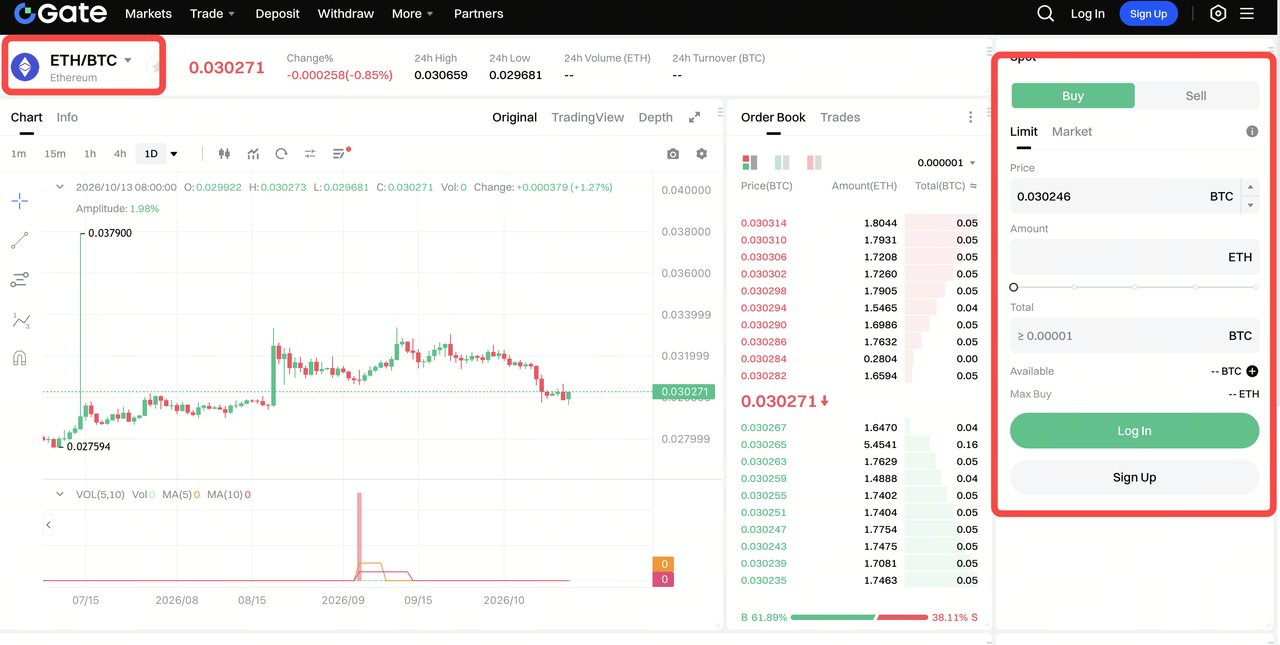
The general process for trading ETH/BTC involves accessing the market, reviewing the order book, choosing an order type, and checking the resulting order status. Availability depends on your account eligibility and the platform’s current requirements.
Visit the ETH/BTC spot trading page on Gate Dubai. Check that the displayed market is ETH/BTC before entering any order details.
Review the current quoted price, available buy and sell orders, and the minimum order requirements shown in the interface. Do not assume that prices or order conditions remain unchanged between visits.
Make sure your account meets the applicable verification requirements and that you have the necessary available balance for the trade. Because BTC is the quote asset in ETH/BTC, buying ETH through this pair generally requires an available BTC balance. The BTC needed for the trade is typically stored in a compatible wallet or your exchange account balance before use.
If you do not already hold the assets required for your intended transaction, first review which markets and funding options are available to your account. An AED-quoted market and an ETH/BTC market serve different purposes, and access to one does not automatically establish access to a particular funding method or another market.
The trading interface may provide different order types. Two common spot order types are market orders and limit orders.
Review the order options currently available on the ETH/BTC page. The exact behavior and conditions of an order depend on the platform’s rules and the selected order type.
Specify the amount of ETH you want to buy or sell, or enter the relevant order details supported by the interface. For a buy order, review the estimated BTC cost. For a sell order, review the expected BTC proceeds.
Check the price, order size, applicable fees, and any displayed total before submitting the order. A market order may execute at more than one price level, while a limit order may not be filled immediately or at all.
After reviewing the details, submit the order and check its status. Depending on market conditions, it may be filled, partially filled, remain open, or be rejected.
Once the trade is completed, review your ETH and BTC balances to confirm the result. Consider the fees and any remaining open orders when checking the final balances. If an order remains open, review its details before deciding whether to keep it active or cancel it.
Trading ETH/BTC may involve fees and execution-related costs. The exact amount depends on the platform’s current fee schedule, your account’s applicable fee tier, the order details, and market conditions.
Bitcoin holders generally rely on capital appreciation rather than native yield generation.
Ethereum can allow investors to earn passive staking rewards on held ETH, separate from exchange trading fees.
Trading fees: A fee may apply when a spot order is executed. Check the current fee rules on Gate Dubai rather than assuming that every order or account has the same rate.
Bid-ask spread: The best available buying and selling prices may differ. This spread is a market cost to consider when evaluating an entry or exit.
Execution price differences: A market order may be matched against multiple price levels. As a result, the average execution price can differ from the price initially displayed.
Blockchain network fees: A spot trade on the exchange is different from an on-chain transaction. Ethereum gas fees generally apply when using the Ethereum blockchain, such as when transferring ETH on-chain, using ETH to pay transaction fees, or interacting with a smart contract. Such fees are distinct from exchange trading fees and may also differ from any withdrawal fee charged by a platform.
Review the order preview and applicable platform terms before confirming a trade.
ETH/BTC is a cryptocurrency trading pair, and both ETH and BTC are volatile crypto assets unlike many traditional assets. Because the pair measures their relative value, its price can move even when both assets move in the same direction against fiat currencies. Bitcoin has a maximum supply of 21 million coins, while Ethereum does not have a hard cap on supply. That fixed supply helps support Bitcoin’s reputation as a macro asset and a potential hedge in uncertain conditions. Ethereum is also increasingly considered by some market participants as a reserve asset.
Liquidity and execution conditions are also important. A displayed price does not guarantee that an order will be filled at that price, and larger orders may be executed across multiple price levels. Review the order book and understand the selected order type before submitting an order.
Operational security matters as well. Use strong account credentials, enable available security features, and be cautious of phishing messages or websites that imitate legitimate services. If transferring assets outside the exchange, verify the destination address and supported network carefully. Blockchain transfers may be irreversible once confirmed.
This article is for educational purposes only and does not constitute financial or investment advice. Understand the risks and the platform’s applicable requirements before trading, and review multiple sourced opinions as both assets have also gained legitimacy through exchange-traded products in global markets.
ETH/BTC is a cryptocurrency spot trading pair that expresses the price of Ether in Bitcoin. ETH is the base asset, BTC is the quote asset, and the displayed price indicates how much BTC corresponds to one ETH. The pair measures the relative value of the two assets rather than the value of either asset in AED.
Before trading ETH/BTC on Gate Dubai, review the current market price, order book, available BTC balance, order type, and applicable fees. Understanding how the pair is quoted—and how it differs from ETH/AED and BTC/AED—can help you interpret the market and review order details more accurately.
ETH/BTC is a trading pair that expresses the price of Ether (ETH) in Bitcoin (BTC). Its quoted price indicates how much BTC corresponds to one ETH at that moment.
No. ETH/BTC quotes the price of one ETH in BTC, while BTC/ETH quotes the price of one BTC in ETH. The base asset and quote asset are reversed, so the quoted values use different units.
The ETH/BTC pair is designed for trading ETH against BTC. A buy order exchanges BTC for ETH, subject to the available market, account eligibility, order conditions, and applicable fees.
ETH/BTC expresses the price of ETH in BTC, while ETH/AED expresses the price of ETH in UAE dirhams. The former is a crypto-to-crypto pair; the latter is quoted in AED. The availability of an AED-quoted pair does not by itself confirm that direct AED deposits are supported for every user.
The pair changes as the relative supply and demand for ETH and BTC change. Historically, the ETH/BTC ratio has fluctuated between about 0.02 and 0.12, which shows what can happen when ETH begins to outperform BTC. It reached an all-time high near 0.14 in 2017. Ethereum network activity, Bitcoin-related developments, market liquidity, and broader market conditions can affect the two assets differently.
Buying ETH through ETH/BTC generally requires an available BTC balance because BTC is the quote asset. The requirements for selling ETH or using other trading pairs may differ. Check the available balance and order details shown on the platform.
No. Exchange trading fees may apply when an order is executed on the spot market. Ethereum gas fees generally apply to transactions processed on the Ethereum blockchain, such as on-chain transfers or smart-contract interactions. Its handling of transaction fees also differs from Bitcoin’s broader monetary setup because ETH supply is not capped like Bitcoin’s 21 million coins.
No. A market order seeks execution at available prices, but the final execution price can differ from the price displayed when the order is submitted. The difference may be more noticeable when liquidity is limited or market conditions change quickly.
The content herein does not constitute any offer, solicitation, or recommendation.
Virtual assets may lose their value in part or in full and are subject to extreme volatility at times. The owner and/or investor in a virtual asset can lose all the money or other value they invest and does not benefit from any form of financial protection. You should always seek independent professional advice before making any investment decisions. Gate Dubai is the trading name of Gate Technology FZE, which is licensed and regulated by the Dubai Virtual Assets Regulatory Authority (VARA) (VASP Reference No. VL/25/04/007) to provide virtual asset exchange services in the Emirate of Dubai. Please note that Gate Dubai may restrict or prohibit the use of all or a portion of the Services from Restricted Locations. For more information, please read the User Agreement via https://www.gate.com/en-dubai/legal/user-agreement.
* The information is not intended to be and does not constitute financial advice or any other recommendation of any sort offered or endorsed by Gate.
* This article may not be reproduced, transmitted or copied without referencing Gate. Contravention is an infringement of Copyright Act and may be subject to legal action.
Share
Content